Vanderbilt-Ingram Cancer Center will host two specialized retreats for lung care in October for colleagues across the organization to collaborate, review progress and identify opportunities to improve patient outcomes.
The event co-chairs are also co-leaders for the Thoracic Oncology program at Vanderbilt-Ingram: Fabien Maldonado, MD, MSc, Director of Interventional Pulmonology at the Vanderbilt Lung Institute, and Evan Osmundson, MD, PhD, Vice Chair of the Department of Radiation Oncology.
They worked in partnership with Melinda Aldrich, PhD, MPH, Professor of Medicine in the Division of Genetic Medicine and Clinical Pharmacology, for the research-based retreat. Aldrich is an accomplished lung cancer investigator and holder of the Robert A. Goodwin, Jr., MD, Directorship
“These retreats allow us to reflect on our progress, strengthen collaborations across disciplines and identify opportunities to further improve care for patients with lung cancer. We remain focused on building the most patient-centered, data-driven lung cancer program in Tennessee,” said Maldonado, holder of the Pierre Massion Directorship in Lung Cancer Research.
“At our last retreat, we launched a real-time lung cancer time-to-treatment tracker in Tableau to monitor patients through the referral, workup, and treatment pipeline,” Osmundson said. “Gathering again allows us to build on that momentum and continue elevating patient care.”
Research Retreat (Friday, Oct. 2, 9 a.m.-1 p.m.): Open to all researchers across all disciplines at 3401 West End Ave., Second Floor, Suite 290.
Clinical Retreat (Friday, Oct. 30, 7:30 a.m.-1 p.m.): Open to clinical practitioners and team members involved in lung cancer care and research, Scarritt Bennett Center, 1027 18th Ave. S.
These collaborative sessions offer a valuable opportunity for teams to align around the long-term strategic vision for the lung cancer program as well as assess program performance against national and regional benchmarks.
There will also be time to discuss and identify initiatives to drive progress over the next few years.
When Melissa Glass met with Aimal Khan, MD, Assistant Professor of Surgery at Vanderbilt Health, to make a surgical plan for her recently diagnosed colon cancer, she had one big request.
She wanted to be back home in Morgantown, Kentucky, and healthy enough to participate in an annual event for Butler County Schools students that is close to her heart.
“It was important to me to make it to our Happy Feet program, where we provide free shoes for students who are underprivileged,” she explained. “They get to pick their shoes out before school starts, and I look forward to this event all year. We fundraise for it, and it’s just such a great day.
“I promised my co-workers I would sit and not help set up boxes, so I behaved and didn’t overexert myself. We love our students, and I was just so happy I was there.”
Glass, a family resource coordinator for the school system, was overwhelmed when health symptoms led to a colon cancer diagnosis at age 44. She is among a growing number of young adults diagnosed with early-onset colorectal cancer, a trend that led the American Cancer Society to update their recommendation to begin screenings at age 45 rather than 50.
Glass talked to a friend who had a similar experience, and they recommended Khan, who had been their surgeon. Khan recommended a minimally invasive, robot-assisted approach to remove the sigmoid colon cancer using a newer, single-port (SP) robotic platform.
“Vanderbilt is among the highest volume, single-port robotic colorectal surgery programs in the United States,” Khan said. “The SP platform allows us to complete an entire colon or rectal operation through one small incision, usually hidden at the bikini line or around the belly button, rather than four or five separate incisions required by conventional robotic or laparoscopic surgery. Very few centers in the country have the training and case volume to offer this for complex colorectal disease.”
Minimally invasive, robotic procedures have been in use for more than two decades and have now become common throughout the world. More recent improvements in the size and function of individual surgical tools, and advances in robotic technology, have made single-port surgeries possible, according to Matthew Spann, MD, Associate Professor of Surgery and Chief of the Division of General Surgery at Vanderbilt Health.
Single-port robotic systems feature small surgical instruments and a camera that are inserted through a tube in a single incision. The instruments, such as scissors, forceps and graspers, can pivot 360 degrees, giving surgeons better access to structures during complex procedures.
And while the aesthetics of having just one small incision rather than several is certainly positive, more importantly, SP colorectal surgeries have been proven to have similar outcomes when compared to a conventional surgical approach, Khan said.
“This is what separates a real advance from a cosmetic one,” he explained. “Complication rates are comparable to the conventional approach. For our cancer patients, we removed the same number of lymph nodes and achieved clean margins around the tumor at the same rate, which are the two measures that determine whether a cancer operation provides the best chance for a cure.”
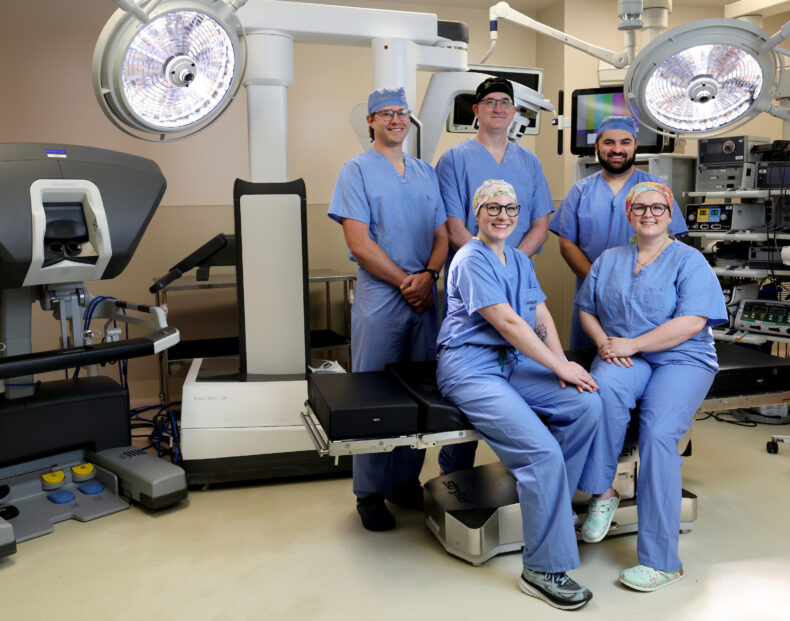
Members of the Vanderbilt Health Colon and Rectal Surgery team in front of the single-port (SP) robotic system they use for colorectal surgeries. The team includes, front row, left to right, Katie Martin, PA-C; and Shannon McChesney, MD. Back row, left to right, Phillip Williams, MD, MSc; M. Benjamin (Ben) Hopkins, MD; and Aimal Khan, MD. (photo by Donn Jones)
Other results for SP colorectal surgeries at Vanderbilt Health are just as impressive:
Patients who have these surgeries go home up to 50% sooner. The length of stay after most SP colorectal surgeries is one day, with a significant number of patients going home the same day.
Patients need substantially less post-surgery narcotic pain medication (25% less), and many go home without an opioid prescription at all. Since every postsurgical opioid prescription is a potential entry point to long-term opioid use, this is important.
Patients report less interruption to their lives, as well as satisfaction with the procedures overall.
Factors that contribute to the success of SP robot-assisted surgeries are the volume of procedures performed at a health care center, as well as the specialized, intensive training clinicians obtain to perform these procedures, said Spann.
“Training in minimally invasive robotic procedures — now including single-port surgeries — is increasingly being incorporated into specialty-specific surgical fellowships,” he said. “This is certainly the case here at Vanderbilt Health.”
And training opportunities led by Vanderbilt Health surgeons extend to established surgeons at other health care centers.
“We have hosted dozens of surgeons from all over from the country who have come here to learn from our experience in single-port robotic surgery,” Khan said. “The Vanderbilt Health colorectal team is also among the national leaders in research on single-port robotic colorectal surgery.”
M. Benjamin (Ben) Hopkins, MD, who leads the section of Colon and Rectal Surgery at Vanderbilt, shared the team’s experience recently at the summer meeting of the Piedmont Society of Colon and Rectal Surgeons, a regional professional medical organization.
“The level of national interest in what we are doing with the SP robot has been remarkable,” Hopkins said.
Khan and Hopkins, along with fellow surgeons Shannon McChesney, MD, and Phillip Williams, MD, MSc, have all completed colorectal surgical fellowships and have training in multiport and single-port robotic surgery. Physician assistant Katie Martin, PA-C, was instrumental in getting the program started and now leads training courses for advanced practice providers interested in learning how to use the SP platform. There are plans to train more Vanderbilt Health surgeons on the SP robot.
Single-port robotic surgeries might not be the best surgical approach for every patient, Khan said. Surgical plans are made in collaboration with each patient and depend on the type and location of the cancer, whether previous abdominal surgery has resulted in scarring, anatomy and other conditions.
As for Glass, she spent two nights at Vanderbilt University Hospital. Her recovery following surgery went well, with manageable pain. She credits her family, including her husband, Jon, and their two daughters, and her colleagues at Butler County Schools for supporting her throughout her experience.
Her short recovery time meant she was able to begin chemotherapy treatment at Vanderbilt-Ingram Cancer Center with Cathy Eng, MD, the David H. Johnson Professor of Surgical and Medical Oncology, whom she also praised highly. Glass has just two chemotherapy sessions remaining and is ready to fully return to focusing on her family and the students of Butler County.
“I’m a very private person, so the fact that I’m sharing my story lets you know how I feel about Dr. Khan and the care I received at Vanderbilt,” she said. “I feel like God’s hand was on it because we really didn’t know where to go or what to do. My husband and I quickly knew that we were in the right place.”
Bhagirathbhai Dholaria, MBBS, Associate Professor of Medicine and a hematopoietic cell transplantation specialist, along with peers from several other transplant centers across the country, recently reached a major milestone in stem cell transplantation.
Bhagirathbhai Dholaria, MBBS
Their clinical trial, called ACCESS, showed that using “mismatched donors” for blood or bone marrow transplants is safe, potentially opening the door to cures for blood cancers such as leukemia and lymphoma.
Findings from the ACCESS trial were recently published in the journal JAMA Network Open.
“Many patients need a donor whose tissue type closely matches their own,” Dholaria said. “Historically, patients from racial and ethnic minority groups have had a harder time finding a perfectly matched donor because donor registries included fewer people from their backgrounds.
“As a result, minority patients are referred less often or move more slowly toward transplant because finding a fully matched donor can be difficult. If doctors believe a suitable donor is unlikely, they may never see a transplant physician in the first place.”
Expanding access and opportunity at the same time
The ACCESS trial set out to dismantle this barrier by allowing mismatched, unrelated donors for patients lacking a full match. Typically, traditional clinical trials restrict enrollment to matched donors only.
By eliminating the requirement for a perfectly matched donor, ACCESS opened the door for more Asian, Black, Hispanic and multiracial patients who previously may not have been eligible for a transplant or clinical trial.
Nearly half of participants in this trial identified as members of racially or ethnically underrepresented groups.
Comparing nearly 670 patients across three different studies, Dholaria and colleagues found that ACCESS participants were more than 25 percentage points more likely to come from diverse racial and ethnic backgrounds than those enrolled in other trials. The broader eligibility criteria also expanded the pool of potential donors available to patients.
“The more we broaden access to transplant, the more patients we can give an opportunity for cure,” said Dholaria.
The University of California, Santa Cruz Alumni Association has announced Melinda Aldrich, PhD, MPH, Professor of Medicine in the Division of Genetic Medicine and Clinical Pharmacology at Vanderbilt Health, as one of its 2026 UC Santa Cruz Alumni Awards recipients.
The awards celebrate individuals whose vision, leadership and dedication have made a meaningful impact in their professions, in society, within the university community, and across the globe. Each honoree exemplifies the values and spirit of UC Santa Cruz through their achievements and contributions, according to a release from UC Santa Cruz.
Aldrich, who has authored more than 170 scientific publications and held leadership roles in numerous national and international scientific organizations, joins John Torigoe, James Hein, PhD, Peter Coha, Jim Gunderson, JD, and Stephanie Barron Lu as recipients of the 2026 UC Santa Cruz Alumni Awards; they will be honored Oct. 16 at a UC Santa Cruz celebration gala.
“This year’s Alumni Award honorees reflect the remarkable breadth of what UC Santa Cruz alumni go on to do and the many ways they contribute to their communities and the world,” said Chancellor Cynthia Larive, PhD. “Their accomplishments are distinct, but each has brought curiosity, purpose, and a commitment to making a difference to their work. We are proud to recognize them and celebrate the paths they have taken since their time at UC Santa Cruz.”
Aldrich, who is also Professor of Biomedical Informatics and Thoracic Surgery at Vanderbilt Health, received her BA in biology from UC Santa Cruz in 1992. She is an internationally recognized expert in lung cancer epidemiology with a research focus on lung cancer screening, risk prediction for early detection, genetics, and differences in health outcomes.
She contributed to health policy revisions of national lung cancer screening guidelines by demonstrating that high-risk African American individuals were disproportionately missed by existing screening eligibility criteria, earning her the Vanderbilt Chancellor’s Award for Research.
“I am deeply honored to receive the UC Santa Cruz Ethos Award. UC Santa Cruz helped shape my belief that scientific progress should benefit all communities, and that principle has guided my work,” said Aldrich, who holds the Robert A. Goodwin Jr., MD, Directorship at Vanderbilt Health. “To be recognized for that commitment by UC Santa Cruz, an institution that has meant so much to me, is especially meaningful.”
Researchers at Vanderbilt Health have found that a balance of two closely related cell surface proteins may be critical to the health of the epithelial lining of the gastrointestinal tract, and for suppressing tumor formation in the colon.
The surface proteins are LRIG1, a tumor suppressor, and its cousin LRIG3, for which there have been conflicting reports about whether it cooperates with or opposes the action of LRIG1.
“We show that a balancing act between LRIG1 and LRIG3 keeps a powerful driver of colorectal cancer in check,” said Robert Coffey Jr., MD, Ingram Professor of Cancer Research and Professor of Medicine. “This offers potentially new avenues to explore in the treatment of colorectal cancer.”
Robert Coffey Jr., MD
Coffey is corresponding author of the report published Aug. 31 in the journal Cellular and Molecular Gastroenterology and Hepatology. Co-director of the Vanderbilt Epithelial Biology Center, he is internationally known for his research on mechanisms that drive the development of colorectal cancer, one of the nation’s leading cancer killers.
In 2012, Coffey and his colleagues found that removal of one copy of the Apc gene, the colon cancer “gatekeeper,” in LRIG1-expressing cells results in multiple colonic tumors.
Now they show that removal of both copies of theLrig3 gene in this setting drastically reduces tumor formation, highlighting the antagonistic nature of the LRIG proteins. This suggests that LRIG1 and LRIG3 work together to maintain the balance of cell signaling pathways implicated in cancer.
Matthew Bechard, PhD, was the paper’s first author. Other Vanderbilt co-authors were Zhengyi Chen, Ping Zhao, PhD, Radhika Aramandla, Yilin Yang, Alan Simmons, Kay Washington, MD. PhD, Jeffery Franklin, PhD, and Ken Lau, PhD.
The research was supported in part by the National Cancer Institute (grant R35CA197570), a GI SPORE grant (P50CA236733), and by the Robert J. Kleberg, Jr. and Helen C. Kleberg Foundation.
For years, care incidence gaps were chalked up to money, insurance and getting to the doctor. While those factors are important, they miss one critical detail: that genes and ancestry shape how cancer develops, proving that no two patients are exactly alike.
“Often, we assume that the reason for most gaps in health care outcomes is an inability to access health care, as some patients simply cannot get transportation to get to the hospital or doctors’ appointments, or they lack insurance,” said Somedeb Ball, MBBS, Assistant Professor of Medicine in Hematology/Oncology at Vanderbilt-Ingram Cancer Center. “But in addition to those factors, we must recognize scientifically that we are not all the same. Understanding the biologic differences in genes and ancestry can provide insights into delivering personalized care.”
Ball, who studies genetic mutations in acute myeloid leukemia (AML), an aggressive blood cancer that has a five-year survival rate of only 30%, set out to investigate and get some answers.
The Problem: A Long-Standing Blind Spot
AML is predominantly diagnosed in white populations, and in turn, up to 90% of clinical trial participants are white. As a result, standard classification criteria, risk stratification models, and approach to targeted therapies have been heavily skewed toward European ancestry, which left big gaps in care for patients of color, particularly Black patients.
But AML is driven by complex combinations of multiple genetic mutations rather than a single defect, so targeted therapies designed around European genetic profiles often fail or lead to treatment resistance in other races and ethnicities.
To address this problem, Ball collaborated with Chidiebube Ugwu, MD, of Jefferson Einstein Philadelphia Hospital, and Jude Ossai, MD, of Newark Beth Israel Medical Center. The research team analyzed American Association for Cancer Research (AACR) Project Genomics Evidence Neoplasia Information Exchange (GENIE) data from 2,359 patients with AML (243 Black and 2,116 white) to examine how mutational landscapes differ by race.
The Key Findings: A Distinct Biological Profile
The study revealed significant biological differences in Black AML patients that directly challenge current “race-blind” risk models:
Lower splicing factor mutations: Black patients exhibited lower rates of splicing factor gene mutations compared to white patients.
Unexpected early-onset mutations: Black patients under age 40 showed a significantly higher prevalence of myelodysplastic syndrome-related mutations, such as ASXL1.
Unique co-mutations: Distinct co-mutation patterns were identified in Black patients, particularly involving the RAS/MAPK signaling pathway.
Altered prognostic indicators: Mutations traditionally classified as “favorable” (such as NPM1) provided protective survival benefits in white patients but failed to do the same in Black patients.
“Because existing risk stratification models were built on data from white patients, we must update how we categorize risk to ensure precision care for Black patients,” Ball said.
The Solutions: Re-Evaluating Guidelines and Expanding Clinical Access
These findings underscore that AML cannot be treated with a “one-size-fits-all” strategy. Shared at the 2026 ASCO Annual Meeting and featured in Specialty Pharmacy Continuum, the team’s research highlights an urgent need for the academic community to incorporate ancestry-specific differences into clinical guidelines.
Moving forward, Ball cited two changes that would work toward a more full understanding of AML: actively recruiting a broad and representative cohort of participants in clinical trials, while expanding genomic testing in community settings.
“Expanding access to genomic tools helps doctors understand the drivers of each patient’s cancer, while robust trial participation ensures new therapies benefit everyone and are applicable to people of all racial and ethnic groups,” he said.
Achieving this will require proactive outreach.
“It is our responsibility as investigators and physicians to meet patients where they are, address their concerns, and clearly communicate how participating in research helps both them and future patients. Building truly inclusive precision oncology requires a unified, comprehensive effort from the top down,” Ball said.
On Saturday, Aug. 29, Vanderbilt-Ingram Cancer Center is convening clinicians from across the Middle Tennessee area for a day of collaboration and connection at the Stem Cell Transplant and Cellular Therapy Symposium, held at the Loews Nashville Hotel at Vanderbilt Plaza from 8 a.m. to 4 p.m.
The event theme is “Emerging Applications of Novel Therapies in Hematologic Disorders and Solid Tumors.”
Adetola Kassim, MBBS, MS, Professor of Medicine in the Division of Hematology and Oncology, is the symposium chair and moderator.
Kassim said, “Advances in treatment for hematologic disorders and solid tumors continue to reshape what’s possible for patients. This symposium offers providers a forum to learn from experts, share perspectives, and apply the latest evidence to improve outcomes for their patients.”
Sessions will focus on current advances in stem cell transplantation and cancer cell therapy, and emerging applications of these novel therapies in hematologic disorders and solid tumors.
The event will begin with a welcome from Ben Ho Park, MD, PhD, Director of Vanderbilt-Ingram and Benjamin F. Byrd Jr. Professor of Oncology, and Karen Proctor, MSN, RN, NE-BC, Administrative Director of Nursing.
A limited number of tickets are available for Vanderbilt Health employees at a discounted rate. Use these codes at checkout:
Physicians: VUMCMD
Advanced practice providers, fellows and nurses: VUMCAPPFEL
In a new study published in JAMA, the diagnostic yield of transbronchial lung biopsy was significantly higher when using a cryoprobe versus forceps in a group of patients with pulmonary nodules or masses, recent lung transplant, and diffuse parenchymal lung disease.
Fabien Maldonado, MD, MSc
A transbronchial lung biopsy is a minimally invasive procedure in which a bronchoscope — a thin, lighted tube — is guided through the nose or mouth into the lungs. Tools are then passed through the scope to collect tissue for laboratory analysis to diagnose lung conditions. A cryoprobe is a medical instrument that uses localized freezing to extract tissue. Forceps are used to pinch off tissue for removal, which can be faster but also crushes a portion of the tissue sample.
The FROSTBITE-2 randomized trial showed diagnostic yield during transbronchial biopsy was nearly 10 percentage points higher when performed using a 1.1-millimeter cryoprobe rather than with 2.0-millimeter forceps (88.6% vs 78.8%). The difference was particularly great among patients with pulmonary nodules or masses (83.2% vs 70.1%). In a secondary safety analysis, there were four pneumothoraces (collapsed lungs) requiring chest tube placement in the forceps group (1.6%) compared to none in the cryoprobe group. No patients experienced significant bleeding or respiratory failure events.
“A structurally intact, sufficiently large tissue sample from a targeted area in the lung increases the likelihood of an accurate diagnosis, which is what we strive for every time we perform a transbronchial lung biopsy,” said interventional pulmonologist Fabien Maldonado, MD, MSc, Professor of Medicine and Thoracic Surgery, and Director of Interventional Pulmonology at the Vanderbilt Lung Institute.
“We’re continually investigating ways we can improve these procedures, as accurate diagnoses up-front save time, which may help get patients the treatment they need faster. Evaluating the tools we use, particularly as innovations in this area occur, is an important avenue of investigation.
“Individuals who have known or suspected lung issues deserve to have the best possible diagnostic procedures, so they and their clinical teams have clear evidence of what is occurring in their lungs so informed treatment decisions can be made.”
Previous studies using a 1.9-millimeter cryoprobe have yielded larger lung tissue specimens at higher quality without crushing the sample, but there were also more bleeding and pneumothorax events. The FROSTBITE-2 trial used the 1.1-millimeter cryoprobe which, unlike the larger probes, is small enough to remove the biopsy specimen through the working channel without having to remove the scope, which increases safety.
Certain lots of the cryoprobe went under a Food and Drug Administration Class I recall in March due to reports of rupturing or bursting during activation; none of these events were reported in this trial.
The study was conducted under the auspices of the Interventional Pulmonary Outcomes Group, an international collaborative of clinical experts dedicated to improving patient care in interventional pulmonology through multicenter clinical trials and research. Maldonado, who holds the Pierre Massion Directorship in Lung Cancer Research at Vanderbilt Health, is vice chair of this group.
The trial was completed at nine U.S. medical centers including Vanderbilt Health that perform at least 100 transbronchial biopsies annually and have affiliated institutional centers for lung cancer, lung transplant and interstitial lung disease. Patients enrolled were 18 or older and scheduled to undergo transbronchial biopsy for lung nodules or masses, lung transplant, or diffuse parenchymal lung disease. Five hundred individuals were randomly assigned to either the 1.1-millimeter cryoprobe or the 2.0-millimeter forceps for the biopsy.
“These promising results bring us one step closer to making these vital diagnostic procedures even more safe, accurate and effective,” said Vanderbilt Health interventional pulmonologist Robert Lentz, MD, Associate Professor of Medicine and Thoracic Surgery. “Our team is currently conducting FROSTBITE-3, a randomized controlled trial comparing the 1.1-millimeter cryoprobe with instruments for lymph node biopsies, to determine whether this novel tool may help with molecular testing in patients diagnosed with lung cancer.
The FROSTBITE-2 study is an investigator-initiated trial. It was funded by Erbe, an international business that develops, manufactures and markets surgical systems. The funder had no role in trial design, data collection, data analysis, manuscript preparation, or the decision to publish.
Genome-wide association studies (GWAS) have discovered thousands of “spots” in the genome associated with diseases, including cancer, but understanding how genetic changes contribute to disease remains a challenge.
Artificial intelligence deep-learning models, such as Enformer, can predict how DNA changes might affect gene regulation. Because these models are trained on broad datasets, however, they do not capture tissue-specific contexts.
A research team led by Qing Li, PhD, and Xingyi Guo, PhD, at Vanderbilt Health, and Quan Long, PhD, at the University of Calgary, has now developed an AI transfer learning approach to adapt Enformer for breast and prostate cancer. Transfer learning is an AI technique that uses a pretrained model (in this case Enformer) as the starting point for a new task. The researchers retrained Enformer using tissue-specific transcription factor chromatin immunoprecipitation sequencing datasets (275 for breast and 357 for prostate).
With the new models, they computed regulatory scores for millions of GWAS genetic variants and identified those most likely to affect cancer risk. They further linked the genes to cancer risk through transcriptome-wide association study analyses and showed that many of the identified genes are important for cancer cell growth and are potential drug targets.
The study, reported in PLOS Genetics, showed that the transfer learning models outperformed the base model in identifying clinically relevant, disease-associated genes. The approach offers a generalizable framework for tailoring foundation models to disease-relevant contexts.
“Our findings demonstrate how adapting existing models to more disease-relevant data can significantly improve our ability to uncover genes and variants involved in cancer,” the authors stated.
Guo and Li are in the Department of Medicine Division of Epidemiology at Vanderbilt Health. The research was supported in part by a Canada Foundation for Innovation John R. Evans Leaders Fund grant to Long.
Vanderbilt-Ingram Cancer Center has named Richard Peek Jr., MD, a Co-Leader of its Gastrointestinal (GI) Cancer Research Program, joining Kristen Ciombor, MD, MSCI, who assumed leadership of the program in 2025.
Peek is Professor of Medicine and Director of the Division of Gastroenterology, Hepatology and Nutrition at Vanderbilt Health, where he holds the Mina Cobb Wallace Chair in Immunology. He is an internationally recognized expert in Helicobacter pylori pathogenesis and host-microbial interactions. Peek has led the Division of Gastroenterology, Hepatology and Nutrition since 2004, during which time it has tripled in size and grown its National Institutes of Health (NIH) research portfolio to more than $11 million annually.
“I am beyond excited to be able to serve in this role for the Vanderbilt-Ingram Cancer Center and to have the opportunity to work with such an exceptionally talented and dedicated physician as Kristen Ciombor,” Peek said. “Vanderbilt-Ingram has always supported my career unequivocally, particularly when they provided pilot funding that presaged our successful P01 grant on Helicobacter pylori and gastric cancer. I am honored to take on this responsibility.”
Kristen Ciombor, MD, MSCI (photo by Erin O. Smith)
Peek’s individual research program has been funded by the NIH for more than 30 years and includes R01 and P01 funding from the National Cancer Institute. He has been elected to the American Society for Clinical Investigation, the Association of American Physicians, the American Association for the Advancement of Science, the American Clinical and Climatological Association, and was a charter member of the NIH Gastrointestinal Mucosal Pathobiology Study Section.
He also served as chair of the American Gastroenterological Association (AGA) Council, co-editor-in-chief of Gastroenterology, as a member of the NIH National Institute of Diabetes and Digestive and Kidney Disease Advisory Council and was recently selected to be president President-Elect of the AGA World Gastroenterology Organization.
Ciombor is Associate Professor of Medicine in the Division of Hematology and Oncology at Vanderbilt, where she has been a faculty member since 2017. A board-certified medical oncologist specializing in gastrointestinal cancers, she leads multiple national investigator-initiated clinical trials in colorectal cancer. She is a co-investigator on the Vanderbilt-Ingram GI SPORE grant and leads the National Clinical Trials Network Lead Academic Participating Site grant at Vanderbilt. She also serves as chair of the Colorectal/Anal Working Group for the Eastern Cooperative Oncology Group and is a member of the NCI GI Steering Committee, among other roles.
“I am delighted that Dr. Peek has been selected to co-lead the Vanderbilt-Ingram GI Cancer Research Program,” Ciombor said. “He is a world-renowned gastroenterologist and expert in H. pylori pathogenesis and a true asset to the Vanderbilt research community. I am thrilled to work with him as we continue to strengthen the GI cancer research collaborations at Vanderbilt.”
“GI cancer incidence and mortality rates in our catchment area are worse than the national average, and screening for diseases like colorectal cancer also are lower in Tennessee than in many other states,” said Ben Ho Park, MD, PhD, the Benjamin F. Byrd Jr. Professor of Oncology and Director of Vanderbilt-Ingram. “GI cancers have been a long-standing priority of the Vanderbilt-Ingram Cancer Center, in part because of the burden of GI cancers in our area, but also because of the exceptional expertise here at Vanderbilt.
“Together, Drs. Peek and Ciombor bring deep knowledge and experience to optimize and personalize the prevention, diagnosis and treatment of GI malignancies. The GI cancer research program at Vanderbilt-Ingram will flourish under their strong co-leadership.”